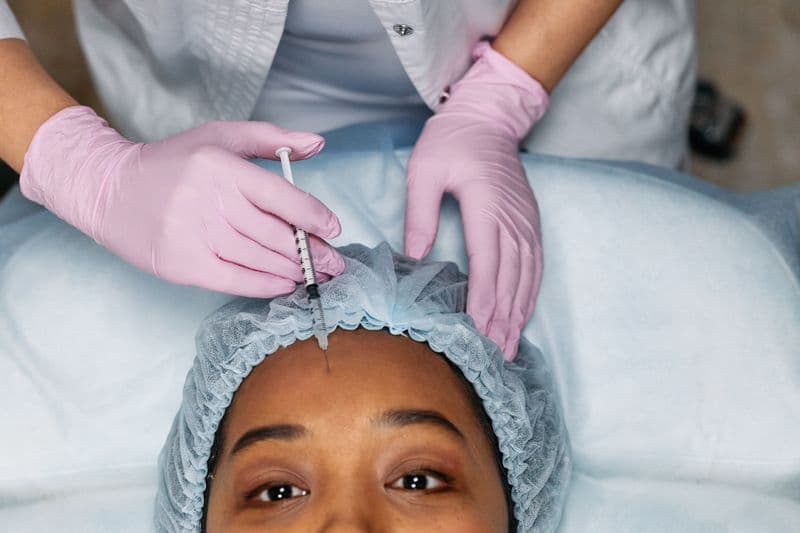
Forehead Botox and glabella Botox treat different muscles, cause different types of wrinkles, and carry different risks. Confusing the two — or treating one without understanding its relationship to the other — is one of the most common sources of Botox complications, including the heavy, tired brow appearance that gives Botox a bad reputation.
Here is exactly what each treatment targets, how dosing works, and why most patients benefit from treating both areas together.
The Anatomy: Two Distinct Muscle Groups
The forehead: the frontalis
The frontalis is a large, flat muscle that runs from the hairline to the brow. Its function is to elevate the brows — when you raise your eyebrows in surprise, widen your eyes, or lift your brows for emphasis while speaking, the frontalis is contracting.
When the frontalis contracts repeatedly over years, horizontal lines form across the forehead — parallel lines running side to side. These are the classic "forehead wrinkles" most patients refer to when they say they want forehead Botox.
Key characteristic: The frontalis is the only significant brow elevator. It has no meaningful muscle partner that shares this function. This matters clinically because over-treating the frontalis — blocking too much of its function — removes the mechanism that holds the brows up. The result is brow ptosis: drooping brows that create a heavy, tired appearance.
The glabella: the corrugators and procerus
The glabella is the area between the brows, above the nose. Three muscles work in this zone:
- Corrugator supercilii: Pulls the brows downward and inward, creating the vertical "11" lines between the brows
- Procerus: Pulls the nose bridge upward and depresses the medial brow, creating the horizontal line at the top of the nose
- Depressor supercilii: Contributes to medial brow depression
When these muscles contract — during concentration, frustration, squinting in bright light, or habitual frowning — they create the vertical lines between the brows. These lines are called glabellar lines, frown lines, or "the 11s."
Key characteristic: The glabella muscles are brow depressors. They work in opposition to the frontalis. This opposing relationship is why treating one area without the other can create problems.
Why Treating Both Areas Together Matters
The frontalis (lifts) and the glabella (depresses) exist in a functional balance. When a patient receives:
Glabella Botox only: The brow depressors are weakened, allowing the frontalis to work relatively unopposed. The brows may lift slightly — a pleasant side effect for many patients. Low risk of brow ptosis.
Forehead Botox only: The frontalis is weakened, but the glabella muscles remain fully active. The depressors now have a relative advantage over the weakened elevator. Brows can drop — creating the heavy, tired appearance that patients fear. This is why isolated forehead Botox without glabella carries higher brow ptosis risk.
Both areas together: The treating injector can balance the elevator/depressor relationship, placing the brows at the desired height while smoothing both horizontal forehead lines and vertical frown lines. This is the gold standard approach for most patients wanting upper face rejuvenation.
The clinical principle: if a patient wants forehead Botox, their injector should always assess whether glabella treatment should accompany it. Most experienced practitioners will have this conversation proactively.
Dosing: How Many Units Does Each Area Need?
Units of Botox (botulinum toxin type A) vary by brand — Botox Cosmetic (Allergan), Dysport, Xeomin, and Jeuveau are all measured differently. The figures below refer to Botox Cosmetic units, which is the most commonly cited standard.
Glabella dosing
The glabella complex typically requires 20–25 units in women, 25–35 units in men for adequate treatment. Men generally have stronger, larger corrugator muscles due to higher androgen levels, requiring higher doses.
The FDA-approved dose for glabella treatment (the label indication for Botox Cosmetic) is 20 units for women. Many practitioners use 20–30 units based on clinical assessment of muscle mass and strength.
The glabella is the safest area to be generous with dosing — within reason — because the corrugators are strong, frown deeply, and tend to drive the deepest, most bothersome lines. Under-dosing the glabella produces a partial, short-lasting result.
Forehead dosing
The forehead requires significantly less product: 8–15 units in women, 10–20 units in men. The frontalis is a large but thin muscle — it does not require the same dose density as the corrugators to produce effect.
Over-dosing the forehead is the most common cause of brow ptosis. Injectors are appropriately conservative here, especially in first-time forehead patients whose muscle behavior and sensitivity are not yet characterized. Starting at the lower end of the dose range and adding units at a 2-week follow-up is safer than aggressive initial dosing.
First-time forehead patients: Many experienced injectors start with a conservative forehead dose (6–10 units) at the first appointment and assess at 2 weeks before adding more. This is not undertreating — it is appropriate caution on a muscle whose over-treatment has lasting consequences.
The Brow Position Question
Before treating either area, a skilled injector will assess the patient's natural brow position and shape. This assessment determines how aggressively to treat each zone.
Low-set brows (brows at or near the orbital rim): These patients are at highest risk for brow ptosis from forehead Botox. The frontalis is working hard to keep brows elevated even at rest. Weakening it significantly risks dropping brows below the orbital rim — a result that cannot be corrected until the Botox wears off. Low-brow patients should receive conservative forehead dosing, often combined with glabella to allow the depressor relaxation to compensate.
High-set, arched brows: More forgiving. The elevated brow position provides a margin before any frontalis treatment would produce visible ptosis. Patients can generally receive standard dosing.
Asymmetric brows: Common and important to note before treatment. Asymmetric dosing between left and right frontalis can correct mild natural asymmetry. Symmetric dosing on asymmetric brows may make the asymmetry more apparent after treatment.
Lines at Rest vs. Lines in Motion: What Botox Can and Cannot Fix
An important distinction before booking either treatment:
Dynamic lines (lines that appear when the muscle contracts, but not at rest) respond excellently to Botox. Preventing muscle contraction prevents line formation.
Static lines (lines visible at rest, without any muscle movement) represent structural changes in the collagen and skin — they are not driven by muscle contraction in the moment. Botox softens static lines over time (by preventing the repeated mechanical stress that deepens them), but it does not immediately erase them.
| Line type | Botox effect |
|---|---|
| Dynamic only | Excellent — lines disappear with treatment |
| Mild static + dynamic | Good — lines reduced significantly, may not fully erase |
| Moderate–deep static | Partial — Botox reduces further deepening; filler or resurfacing addresses the existing depth |
| Deep static only (rare) | Limited — the line is structural, not muscular |
Patients with deep static forehead or glabella lines may benefit from combining Botox (to stop ongoing deepening) with a collagen-stimulating treatment like microneedling or a chemical peel (to address existing structural damage) — but these are separate treatments with separate aftercare requirements.
Aftercare: Same Rules, Different Risk Profiles
The post-treatment rules for both areas are the same as all Botox — see our complete Botox aftercare guide for the full protocol. The key points:
- No touching or rubbing for 4 hours — applies to both areas, particularly important for glabella where the corrugators sit close to the levator muscle of the eyelid
- Stay upright for 4 hours — especially relevant for glabella treatment, where lying face-down increases migration risk toward the eyelid
- No vigorous exercise for 24 hours — see our complete Botox exercise guide for full activity breakdown by type
- Assess results at day 14 — not before
The glabella specifically carries the risk of eyelid ptosis (drooping) if Botox migrates inferiorly into the levator palpebrae. This risk is higher with glabella injections than forehead injections and is why the no-touch and no-inversion rules matter most in the first 4 hours after glabella treatment.
When Results Look Wrong: What to Do
Brow ptosis (heavy, drooping brows): Most commonly from over-treated forehead or from forehead-only treatment without glabella. Cannot be reversed — waits out the Botox duration. Prescription eye drops (apraclonidine, iopidine) can partially compensate by stimulating Müller's muscle. Prevents by conservative forehead dosing and treating the glabella simultaneously.
Spock brow (outer brow elevation while medial brow drops): Occurs when the medial frontalis is over-treated and the lateral frontalis remains active, pulling the outer brow up asymmetrically. Corrected with a small dose (1–2 units) to the lateral frontalis at the 2-week follow-up.
Asymmetry: Asymmetric effect at 2 weeks can be addressed with touch-up dosing on the weaker side.
Plateau effect (wrinkles persisting): If deep static lines remain after Botox is fully active, discuss combination treatment with filler or resurfacing at your follow-up appointment.
For the complete post-injection protocol, see our Botox aftercare swelling guide and Botox during pregnancy FAQ if relevant.
Every Botox forehead and glabella patient should leave with written aftercare instructions covering the 4-hour non-touch window, the 24-hour exercise restriction, and the 14-day result assessment timeline. AftercareGen generates professional, clinic-branded Botox aftercare documents in under a minute.
Stop photocopying aftercare sheets
Generate Botox aftercare instructions branded with your clinic name in under 60 seconds. 3 free sheets per day — no credit card.
Generate your first sheet freeGet the free aftercare template pack
Generators for all 13 aesthetic procedures plus practical guides on running aftercare in your clinic. Sent once — no spam, ever.
Frequently asked questions
About the author
Dr. Megan Cole, RN, BSN
Aesthetic Nurse Practitioner
Registered Nurse with 12+ years in medical aesthetics. Certified injector (AAFE) specializing in neurotoxins and soft-tissue fillers. Clinical educator for aesthetic nursing programs.
View profile