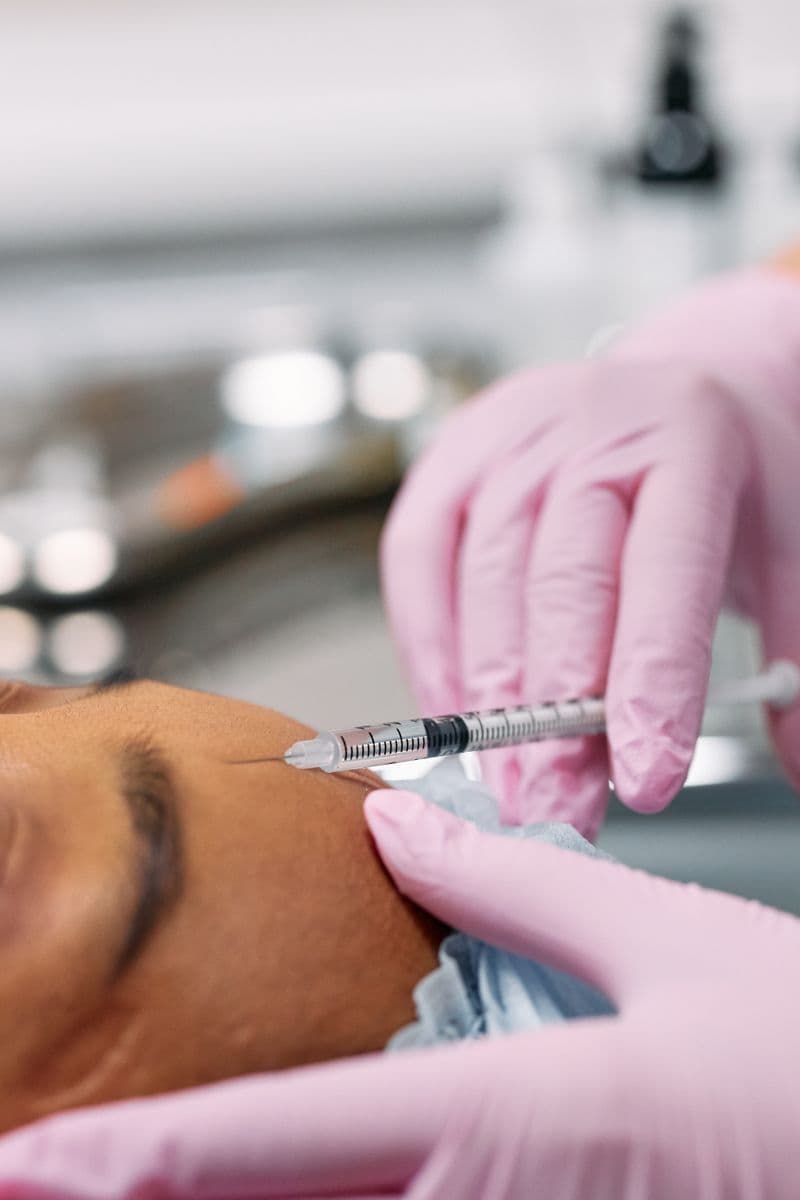
Botox swelling peaks within 4–6 hours of treatment and, in most cases, resolves completely within 24 to 72 hours. The injection itself is the cause — every needle puncture triggers a localized inflammatory response regardless of the product injected. Understanding what is normal versus what warrants a call to your provider is the single most important piece of aftercare knowledge you can have.
This guide walks you through the complete recovery timeline, explains the biology behind post-Botox swelling, identifies the factors that can make it worse, and tells you exactly what to do — and what not to do — in the hours and days following your treatment.
What Actually Causes Swelling After Botox?
Swelling is not a reaction to the botulinum toxin itself — it is a reaction to the mechanical act of injection. When a needle penetrates skin and subcutaneous tissue, the body responds with an immediate cascade:
- Histamine release: Mast cells in the skin release histamine, causing local vasodilation (widening of blood vessels).
- Increased vascular permeability: Dilated capillaries allow plasma to leak into surrounding tissue — this is edema, or what you see as swelling.
- White blood cell migration: The immune system sends neutrophils to the injection site to check for pathogens.
This process is the same whether the injection is saline, vaccine, or botulinum toxin. It is a healthy, functional response, not a sign that something went wrong.
The severity of swelling correlates with two main variables: the number of injection sites (more punctures = more cumulative trauma) and the vascularity of the treated area (areas with richer blood supply, like the lips or periorbital region, swell more readily than the forehead).
The Complete Botox Swelling Timeline: Day by Day
Hours 0–4: Immediate post-treatment
You may notice small, mosquito-bite-like bumps at each injection point within minutes of your appointment. These are completely normal and represent the bolus of fluid (the Botox solution itself, roughly 0.05–0.1 mL per point) sitting in the tissue before it disperses. The skin may also appear slightly red and feel warm.
What to do: Apply a cold compress (wrapped in a cloth) for 10 minutes on, 10 minutes off during the first few hours. Keep your head upright. Do not touch, rub, or massage the area.
Hours 4–8: Swelling peaks
This is the window when swelling reaches its maximum. The injection sites may look noticeably puffy, especially if you had multiple areas treated. If you bruised (which happens in roughly 15–20% of Botox treatments), the bruise may also begin to become visible during this period.
The swelling should be localized — confined to the areas that were injected. Diffuse swelling extending far beyond the injection sites, or swelling of the lips/tongue/throat without having had those areas treated, are signs to seek immediate medical attention.
What to do: Continue cold compresses. Avoid alcohol. Do not exercise. Sleep with your head elevated at 30–45 degrees if possible.
Day 1 (24 hours post-treatment): First real improvement
Most patients wake up on day one with noticeably less swelling than they experienced the evening of treatment. The injection-site bumps are gone. Residual puffiness, if present, is often mild enough to be concealed with makeup at this stage.
If you have bruising, it will likely be at its most visible now — bruises tend to surface fully by day 1–2 even though the bleeding event (micro-trauma to small blood vessels) occurred at the time of injection.
What to do: You can now return to most normal activities. You may apply arnica gel to any bruised areas. Limit extreme exercise and heat exposure for one more day.
Days 2–3: Swelling fully resolves in most patients
By day 3, the vast majority of patients have zero visible swelling from Botox injections. If you are still seeing swelling at this point, it is most commonly due to:
- Bruising that has pooled and appears as raised discoloration
- Periorbital (around the eye) treatments, which have longer resolution curves
- Individual healing variability — some patients, particularly those on blood thinners or with a history of slow wound healing, take longer
The Botox itself has not yet produced its full neuromuscular effect at this stage — that takes 7–14 days.
Days 4–7: Rare extended swelling resolves
For the small percentage of patients whose swelling persists past day 3, it should be steadily improving (not worsening) each day. By day 7, essentially all normal post-Botox swelling has resolved.
If swelling is worsening rather than improving at any point past 48 hours, call your provider. This trajectory is atypical and needs evaluation.
Days 7–14: Botox effect becomes visible
This is not a swelling timeline note, but it is the most important clinical milestone: the neurotoxin finishes diffusing into the target muscles and the paralytic effect becomes fully apparent. Do not judge your results before day 14. Many patients who feel "nothing happened" on day 5 see dramatic results by day 10.
Factors That Make Swelling Worse (And How to Minimize Them)
The baseline swelling from Botox is modest and short-lived. However, several patient behaviors in the hours surrounding treatment can significantly amplify it.
Alcohol consumption
Alcohol is a potent vasodilator — it causes blood vessels to widen, which increases blood flow and makes it easier for plasma to leak into tissue. Drinking within 24 hours before or after Botox measurably worsens both swelling and bruising. The recommendation is to avoid alcohol for 24 hours before treatment and 24 hours after.
Vigorous exercise
Aerobic exercise raises heart rate and blood pressure, increasing blood flow to all tissues — including the freshly injected areas. This can worsen swelling and, more importantly, may cause the Botox to diffuse more widely than intended. Skip the gym for 24 hours post-treatment.
Heat exposure
Hot showers, saunas, steam rooms, and prolonged sun exposure in the first 24 hours all dilate capillaries and worsen swelling. A warm shower is fine; a 20-minute sauna session is not. Avoid heat for 24–48 hours.
Touching or massaging the treated area
This is not just a swelling issue — massaging Botox injection sites within the first 4 hours can mechanically spread the toxin into adjacent muscles, potentially causing unintended effects (including eyelid ptosis, or drooping). Do not touch the treated areas for at least 4 hours.
Blood-thinning medications and supplements
Aspirin, ibuprofen, naproxen, fish oil, vitamin E, and ginkgo biloba all impair platelet function, increasing the likelihood of bruising (which presents as visible tissue disruption often confused for swelling). Discuss these with your provider before your appointment. If you have taken any of them in the 3–5 days before your treatment, let your injector know.
What Reduces Swelling After Botox?
Cold compresses (most effective)
Cold causes vasoconstriction — it narrows blood vessels, reducing the leakage of plasma into tissue. Apply a cold compress (an ice pack wrapped in a thin cloth, or a bag of frozen peas) for 10 minutes on, 10 minutes off during the first 4–6 hours. Do not apply ice directly to skin, which risks frostbite.
Head elevation
Gravity is your friend. Keeping your head above the level of your heart — sitting upright during the day, sleeping with an extra pillow — helps reduce fluid accumulation in the face. Sleeping face-down is one of the worst things you can do in the first 24 hours.
Arnica montana
Arnica is a botanical with mild anti-inflammatory and circulatory properties. While clinical evidence is limited, it is widely used in aesthetic medicine and is considered safe for topical application. Arnica gel applied 2–3 times daily starting the day of treatment may modestly reduce both bruising and swelling. Arnica tablets (sublingual pellets) are also commonly recommended.
Time
This is not satisfying advice, but it is the most reliable one. The biological process of swelling resolution follows a predictable trajectory for Botox. Supporting it with the measures above reduces its severity and duration at the margins — but most of the work is simply done by your body over 24–72 hours.
Normal vs. Not Normal: A Quick Reference
| Symptom | Normal? | Timeline |
|---|---|---|
| Small bumps at injection sites | Yes | Resolves in 30–60 min |
| Redness at injection points | Yes | Resolves in 1–4 hours |
| Mild puffiness | Yes | Peaks 4–8 hrs, resolves 24–72 hrs |
| Bruising (purple/blue discoloration) | Yes (15–20% of patients) | Peaks day 1–2, resolves 5–10 days |
| Mild headache | Yes | Usually day 1, resolves with paracetamol |
| Swelling spreading rapidly beyond injection sites | No | Seek immediate evaluation |
| Swelling worsening after 48 hours | No | Call your provider |
| Difficulty breathing or swallowing | No | Emergency — call 911 |
| Hives, rash, itching beyond injection site | No | Possible allergic reaction — call provider |
When to Call Your Provider
Contact your injector or a medical professional promptly if you experience:
- Ptosis (eyelid drooping): A rare but known Botox complication caused by toxin diffusion into the levator palpebrae muscle. Typically appears 2–7 days post-treatment and can last several weeks. Prescription eye drops can help.
- Asymmetry: Some asymmetry in the first 2 weeks is normal (Botox takes effect at different rates in different muscles). If you are still significantly asymmetric at day 14, your provider may be able to correct it with a small touch-up.
- Swelling that worsens rather than improves after 48 hours.
- Any systemic symptoms: fever, widespread rash, difficulty swallowing or breathing.
When Do Botox Results Appear? The Full Timeline
The question most patients have by day 3 is: "Did it work?" The botulinum toxin is still establishing its effect. Here is the complete neuromuscular timeline:
| Timepoint | What is happening | What you may notice |
|---|---|---|
| Hours 0–24 | Toxin binding to nerve terminals at injection sites | No visible effect; possibly small injection bumps |
| Days 3–5 | Acetylcholine release begins to be blocked | First sense that the muscle "feels different" |
| Days 7–10 | Muscle relaxation becomes clinically visible | Lines soften, frown reduced, crow's feet ease |
| Day 14 | Full effect established | Accurate result assessment; contact provider if concerns |
| Months 3–4 | Nerve terminal regeneration begins | Gradual return of muscle movement |
| Months 4–6 | Effect fully faded | Time for next treatment if desired |
Do not judge your results before day 14. First-time patients who feel "nothing happened" at day 5 commonly see dramatic results by day 10.
Genuine non-response (no effect at day 14) is uncommon and usually caused by pre-existing antibodies to botulinum toxin — more likely after many prior treatments — or by product stability issues. Discuss with your provider at a day-14 review if you suspect true non-response.
Side Effects vs. Complications: Know the Difference
| Symptom | Category | Expected timeline | Action |
|---|---|---|---|
| Small bumps at injection sites | Normal side effect | Resolves 30–60 min | None needed |
| Redness at injection points | Normal side effect | Resolves 1–4 hours | Cold compress if desired |
| Mild puffiness at injection sites | Normal side effect | Peaks 4–8 hrs, resolves 24–72 hrs | Cold compress, elevation |
| Mild headache | Common side effect | Day 1, resolves with paracetamol | OTC pain relief |
| Bruising (purple/blue discoloration) | Common side effect (~20%) | Peaks day 1–2, resolves 5–10 days | Arnica gel, makeup cover |
| Temporary heaviness in treated area | Expected response | Days 2–7 as effect establishes | No action |
| Asymmetry persisting past day 14 | Possible complication | Should be reassessed | Contact provider |
| Eyelid ptosis (drooping) | Rare complication | Appears days 2–7, lasts weeks | Prescription eye drops; contact provider |
| Swelling worsening after 48 hours | Atypical response | Should be improving, not worsening | Contact provider |
| Difficulty swallowing or breathing | Emergency | Any time | Emergency services immediately |
| Hives, rash, systemic reaction | Rare allergic reaction | Any time | Immediate medical attention |
About eyelid ptosis
Ptosis is the most feared Botox complication. It occurs when toxin diffuses from forehead or glabellar injection sites into the levator palpebrae muscle. Risk is reduced by staying upright for 4 hours post-treatment, not touching or massaging injection sites, and not exercising vigorously in the first 24 hours.
If ptosis occurs, apraclonidine 0.5% eye drops (prescription) can partially temporarily lift the eyelid by stimulating Müller's muscle. Contact your provider as soon as you notice drooping. Ptosis resolves as the Botox effect fades, typically within 4–6 weeks.
The Complete Botox Aftercare Checklist
First 4 hours
- Do not touch, rub, or massage injection sites
- Apply cold compress (cloth-wrapped, not ice directly) for 10 minutes on/off
- Stay upright — do not lie down
- No strenuous exercise
- No alcohol
- No heat exposure (sauna, steam room, sunbathing)
- No facial massage or treatments
First 24 hours
- Continue avoiding vigorous exercise
- Continue head elevation when resting
- Avoid alcohol
- Avoid sleeping face-down; sleep with head slightly elevated
- Apply arnica gel to bruised areas if present
- Wait 24 hours before applying makeup directly to injection sites
First 2 weeks
- Do not evaluate results before day 14
- Resume all normal activities after 24 hours
- Book a follow-up review for day 14 if any concerns arise
- Contact provider promptly for any atypical symptoms (asymmetry beyond day 14, ptosis, worsening swelling)
Use a Professional Aftercare Sheet for Every Patient
If you are an aesthetic practitioner reading this: your patients are going to Google "how long does Botox swelling last" within 24 hours of their appointment. What they find matters.
The most effective thing you can do is provide them with clear, personalized written aftercare instructions at the point of care — before they have a question that drives them to unvetted sources. A well-written aftercare sheet covers:
- What is normal (and what isn't) with a concrete timeline
- Specific do's and don'ts for the first 24 and 48 hours
- Who to call and when
- A reminder of their follow-up appointment
Related guides: how long after Botox can you exercise · Botox lip flip aftercare · Botox forehead vs glabella
AftercareGen generates professional, branded aftercare PDF documents for Botox and 12 other aesthetic procedures in seconds — customized to your clinic name, treatment details, and patient instructions. No more hand-writing or generic printed sheets.
Stop photocopying aftercare sheets
Generate Botox aftercare instructions branded with your clinic name in under 60 seconds. 3 free sheets per day — no credit card.
Generate your first sheet freeGet the free aftercare template pack
Generators for all 13 aesthetic procedures plus practical guides on running aftercare in your clinic. Sent once — no spam, ever.
Frequently asked questions
About the author
Dr. Megan Cole, RN, BSN
Aesthetic Nurse Practitioner
Registered Nurse with 12+ years in medical aesthetics. Certified injector (AAFE) specializing in neurotoxins and soft-tissue fillers. Clinical educator for aesthetic nursing programs.
View profile